The acrobat was one of the labs from the UPenn Mechatronics course. The course combined knowledge from mechanical design, electrical engineering, and computer science in a fast-paced integrated curriculum. The goal of the acrobat was to create a free-standing two-wheeled robot that could balance a top-heavy load, similar to how a Segway works.
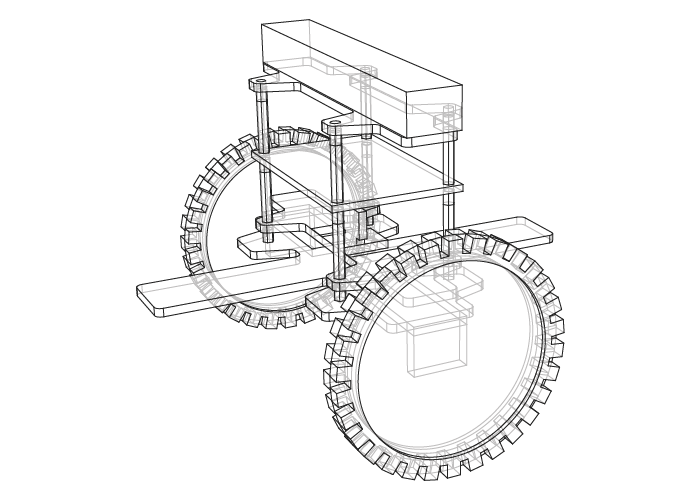
For the mechanical design of the acrobat we created a simple structure that would allocate space for the circuit board, batteries, and weights, in order to meet the project requirements. To minimize the amount of error caused by the jitter from the motors, we designed the sensor to be placed near where we wanted our center of mass, which was our ideal center of rotation. We planned on using proportional and derivative feedback to provide the necessary torque on the motors to stay upright.
We wanted the motors to move both back and forth so we used the SN754410 H-Bridge with our M2 microcontroller. We designed the circuit so the M2 controlled motors independently and pulse-width modulated the enable lead on the H-Bridge to regulate the speed of the motors.
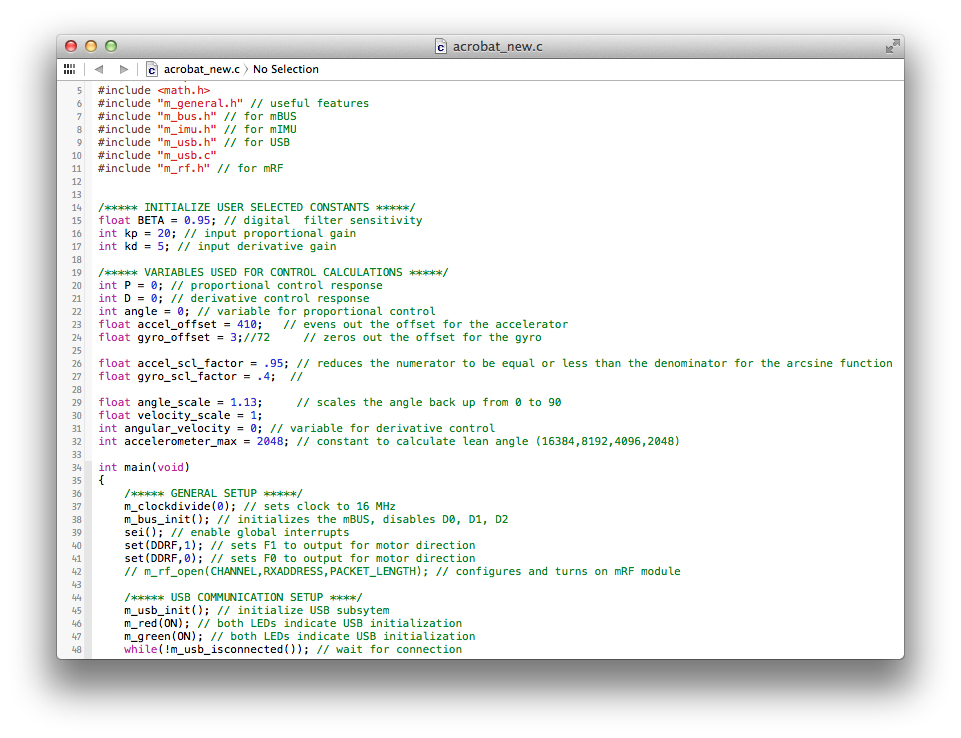
To create the effect of speeding up and slowing down, we had to imitate the analog affect through digital pulse width modulation on the motors. To create this we had to enable the M2's clock timer to allow us to alter the strength of the enable lead on the H-Bridge. In addition, to achieve the correct control scenario, we reduced the interference from the shaky sensor reading using a digital band-pass filter.